

The Long Arm of Heresy
...from Trent to Trump

A grand smokescreen
The entire world is focused on the American financed, Israeli initiated attack on Iran. This war has many dimensions. It is not only affecting the countries of the Middle East; but has enormous economic, political, and cultural impacts of international proportions. Intentionally or not, coverage of the war has drawn away attention from the more consequential events occurring in the United States and around the world pertaining to the establishment of Sunday sacredness.
For example, very little is being said about Roman Catholic Cardinal Raymond Burke of New York offering prayer for the dedication of the nation to the Sacred heart of Mary for its 250 year celebrations. To anyone knowing anything about the formation of the United States, this act must be mindboggling. The American Experiment is the child of the Protestant Reformation and a revolution against church/state tyranny which the Roman church embodies.
Celebrated Founding Father, James Madison, expressed it this way, specifically citing the Papal Monarchy, "In the Papal System, Government and Religion are in a manner consolidated, & that is found to be the worst of Govts. In most of the Govts. of the old world, the legal establishment of a particular religion and without or with very little toleration of others makes a part of the Political and Civil organization and there are few of the most enlightened judges who will maintain that the system has been favorable either to Religion or to Govt."
(James Madison, Letter to Jasper Adams September 1833).
For a profoundly influential Roman Catholic prelate to offer a prayer for the dedication of the nation to the sacred heart of Mary testifies to the effectiveness of the papacy’s Counter Reformation project. It’s also one giant step in the fulfilment of Bible prophecy foretelling the unification of the the United States with the Roman Papacy. Since its inception at the Council of Trent, this 16th century ecumenical council of the Roman Catholic Church held in the northern Italian city of Trent between 1545 and 1563, established the foundation for the Catholic Counter-Reformation.
During the council several doctrinal issues were discussed and debated. Among them were Scripture vs Tradition, Justification, the Sacraments, Clerical Discipline, and Liturgical Standardization. The Council specifically reaffirmed transubstantiation—the belief that bread and wine literally become Christ’s body and blood. Moreover, the Catholic leaders pointed out a logical inconsistency in the Protestant “Sola Scriptura” position regarding the day of worship.
The debate on the day of worship was resoundingly resolved by the speech of Archbisop of Reggio, Gaspar de Fosso. He argued, “The Protestants claim to stand upon the written word only. They profess to hold the Scripture alone as the standard of faith. They justify their revolt by the plea that the Church has apostatized from the written word and follows tradition. Now the Protestant claim, that they stand upon the written word only, is not true. Their profession of holding the Scripture alone as the standard of faith is false.
He continued: The written word explicitly enjoins the observance of the seventh day as the Sabbath. They do not observe the seventh day but reject it. If they do truly hold the scripture alone as their standard, they would be observing the seventh day as is enjoined in the Scripture throughout. Yet they not only reject the observance of the Sabbath enjoined in the written word, but they have adopted and do practice the observance of Sunday, for which they have only the tradition of the Church. Consequently, the claim of ‘Scripture alone as the standard’ fails; and the doctrine of ‘Scripture and tradition’ as essential, is fully established, the Protestants themselves being judges” (Archbishop of Reggio, Gaspar de Fosso’s address in the 17th session of the Council of Trent, Jan. 18, 1562, in Mansi SC, Vol. 33, cols. 529, 530).
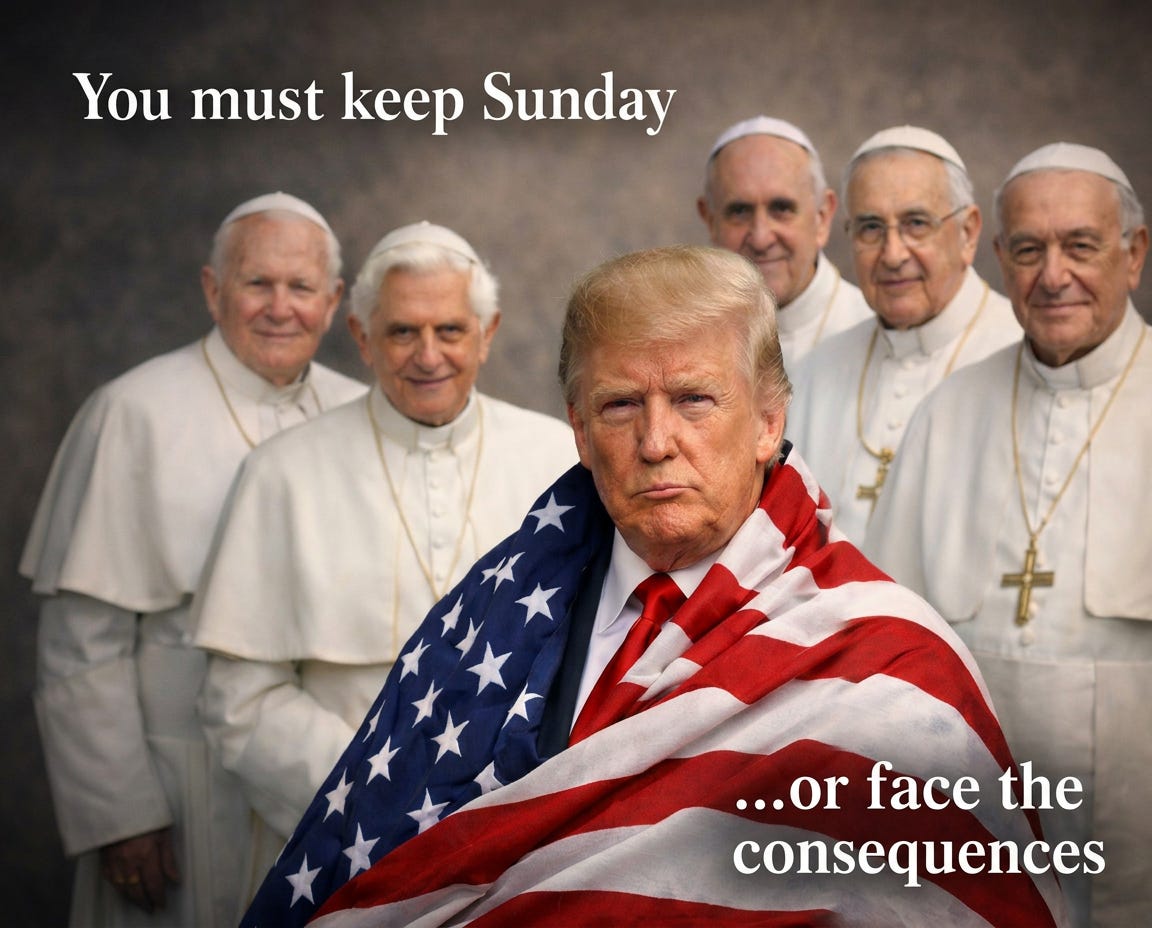
Gaspar de Fosso’s speech and the subsequent unanimous adoption of his position laid the most solid plank for the success of Rome’s Counter Reformation Project. It provided the fuel for powering the church’s prime objective of establishing its Sunday sacredness on the inhabitants of planet earth. Dedicating the nation to the sacred heart of Mary is the latest plank. The current president’s embrace of Christian Nationalism with its fierce promotion of Sunday sacredness is totally in sync with Rome’s Counter Reformation Project; but totally antagonistic to the prosperity of the American Experiment and contrary to the word of God.
Confronting Rome’s error
But you don’t have to accept Rome’s unbiblical position on the Lord’s day. Despite its popularity, you need not be deceived. Permit me, please, to cite some of those famous, false narratives on Sunday sacredness and offer you the sound Biblical perspectives.
Creation week is not really seven literal days, but rather 7,000 years. Therefore, God could not be talking about a literal 7th day rest in the Sabbath Commandment.
What an insult to God and a disavowal of His inspired word. The passage of Scripture misused to justify this position reads, “But, beloved, be not ignorant of this one thing, that one day is with the Lord as a thousand years, and a thousand years as one day” (2 Peter 3:8).
Firstly, Peter’s declaration is not a statement of comparison, but rather, one of contrast. He is simply contrasting our way of thinking with that of God’s. The prophet Isaiah earlier stated, “For my thoughts are nor your thoughts, neither are your ways my ways, saith the Lord, for as the heavens are higher than the earth, so are my thoughts higher than your thoughts.” (Isaiah 55:8,9) Secondly, the subject of Peter’s discourse is not at all about creation. Instead, he is attempting to alleviate the doubts and fears of those who question another plainly revealed Bible truth—the visible, literal second coming to earth of our Lord and Savior, Jesus Christ. The apostle is assuring his hearers of the veracity of God’s word in general, and the certainty of the second coming of Our Lord and Savior, Jesus Christ, in particular. Peter is most importantly talking about God’s patience and longsuffering with us sinful human beings.
Jesus rose from the dead on the first day of the week. So we honor it as the Lord’s day and made it the Sabbath-day.
Here is a classical example of the devil’s trickery of mixing truth with error. It is quite unfortunate that so many of God’s professed followers are accepting this as Bible truth. The record is clear. Jesus was resurrected on the first day of the week, today called Sunday. All four of the Gospels record this account. Only one is needed to establish this fact, for they all agree perfectly: “And when the Sabbath was past, Mary Magdalene and Mary the mother of James, and Salome, had brought sweet spices that they might come and anoint Him… And very early in the morning, the first day of the week, they came to the sepulchre at the rising of the sun… and he (the angel) said unto them, be not affrighted: ye seek Jesus of Nazareth, which was crucified: He is risen, He is not here: behold the place where they laid Him” (Mark 16: 1,2,6) This is truth, unadulterated truth. Nowhere does the Scripture endorse Sunday sacredness in honor of Jesus’ resurrection. Neither Jesus, the prophets nor apostles taught such a doctrine. The origin of this heresy is popery.
In the Catechism of the Christian Doctrine and Practices, we find this testimony:
Question: Why does the church command us to keep the Sunday holy instead of the Sabbath?
Answer: The church commands us to keep the Sunday holy instead of the Sabbath because on Sunday Christ rose from the dead, and on Sunday He sent the Holy Ghost upon the apostles.
God’s law, including the Sabbath Commandment, was nailed to the cross. Therefore we no longer have to keep the law.
What a frightening thought? It is impossible for God to negate His law in anyway. Such a teaching defies basic common sense and cannot be established by the word of God. God’s law is the very foundation of His government. It is His constitution, laid down for all men, in all times to obey. His law is the expression of His will. God’s law provides the norms and defines the parameters by which He expects His children to live. It is the most ridiculous notion to suggest that it was done away with at the cross. Why would Jesus pay such a price, die such an ignominious death in order to rid the world of the law of God? The plain answer is that He did no such thing.
Quite to the contrary, Jesus declares, “Think not that I am come to destroy the law or the prophets. I am not come to destroy but to fulfill. For verily I say unto you till heaven and earth pass, one jot or tittle shall in no wise pass from the law, till all be fulfilled. Whosoever therefore shall break one of these least commandments, and shall teach men so, he shall be called the least in the kingdom of heaven: but whosoever shall do and teach them, the same shall be called great in the kingdom of heaven.” (Matthew 5:17-19). Jesus’ job is to empower us to keep the law. He has not given anyone authorization to break or destroy His law, and He most certainly did not do away with it.
The disciples ceased to keep the Sabbath-day and kept Sunday as the Lord’s Day.
If one will even casually examine the sacred record, they will discover that indeed the seventh-day Sabbath was not done away with at the cross. It was, most definitely, observed by the disciples and the early church long after Christ’s death and resurrection.
Paul, a minister of the Gospel of grace and an ardent proponent of keeping all of God’s Holy law, did not abandon the Sabbath commandment. He kept it the way he knew God had ordained. He was a commandment-keeping Jew who continued to keep and teach God’s law when He became a Christian. Luke records, “And Paul, as his manner was, went in unto them on the Sabbath day and reasoned with them out of the Scriptures.” (Acts 17:2) He continued, “And he reasoned in the synagogue every Sabbath, and persuaded the Jews and the Gentiles” (Acts 18:4). This claim from Sabbath to Sunday after Jesus’ resurrection is un-Biblical and groundless. It must therefore be rejected.
Paul teaches that we may choose whatever day we want, so long as we choose one day in seven to rest.
How absurd. To comfort and confirm themselves in this erroneous doctrine, its proponents cite Paul’s writings in the book of Romans: “One man esteemeth one day above another: another esteemeth every day alike. Let everyman be fully persuaded in his own mind. He that regardeth the day regardeth it unto the Lord; and he that regardeth not the day to the Lord he doth not regard it. He that eateth, eateth to the Lord, for he giveth God thanks, and he that eateth not to the Lord, he eateth not, and giveth God thank” (Romans 14:5-6).
Nowhere in this passage does Paul refer to the keeping of the Sabbath-day. Paul, along with the other disciples kept holy God’s seventh-day Sabbath after the death and resurrection of Jesus Christ. To say on one hand that God’s Sabbath was done away with at the cross, and now subscribe to the notion that Paul is here teaching the church to observe whatever day they choose, in honor of God’s Sabbath, is self-contradictory heresy of the highest order. Paul is not a teacher of heresy. Neither does he contradict the teachings of Jesus or the prophets. Our God, the Creator, the God of the Sabbath is not a God of confusion. He is a God of order and specificity. To suggest that each one may keep the Sabbath on whatever day he chooses is confusion. It is exactly what we have in the religious world. God calls this confusion Babylon.
Jesus Is my Sabbath: So I don’t have to keep His Sabbath
This is the most self-contradictory argument in the arsenal of those who choose not to honor Creator God by keeping holy His blessed Sabbath-day. The class who proposes this theory is quick to point to the words of Jesus who is lovingly calling us all: “Come unto me, all ye that labour and are heavy laden, and I will give you rest. Take my yoke upon you, and learn of me; for I am meek and lowly in heart: and ye shall find rest unto your souls” (Matthew 11:28-29).
Let’s examine the suicidal nature of this position. In speaking to an agrarian society of which He was a part, Jesus primarily used figurative language to help His hearers better understand His teachings. We know them as parables. His appeal to find rest in Him is certainly of a similar caliber and one to which his listeners could have related. A yoke is a wooden agricultural implement that is placed around the necks of two animals, usually oxen. It is designed to keep the animals together thus providing increased energy in carrying out such tasks as ploughing and pulling of heavy burdens. Jesus therefore uses this metaphor to illustrate the closely knit relationship He wants with His followers. In the case of the oxen that are yoked up together, one naturally goes where the other goes.
Now, if you claim Jesus to be your rest and you are yoked up with Him, then the question to be answered is, ‘when He keeps holy His Father’s blessed Sabbath-day, what do you do?’ The Gospel writer Luke enlightens us regarding Jesus’ attitude God’s Sabbath-day. He writes, “And He [Jesus] came to Nazareth, where He had been brought up: and, as His custom was, He went into the synagogue on the sabbath day, and stood up for to read” (Luke 4:16). What is your custom? Perhaps now is the time to seriously consider if you are yoked up with Him and if He is indeed your Rest.
As the war against Iran escalates and the false narratives surrounding it are promoted, one must not loose sight of the fact that Rome’s battle against God’s Sabbath rages on. From Trent to Trump, secretly and openly, the controversy continues. Every pope and Catholic prelate persistently advance the Sunday heresy. Don’t be surprised if Rome proposes its Sunday sacredness as a panacea for the US-Israel/Iran conflict.